Kinkaku-ji
Kyoto
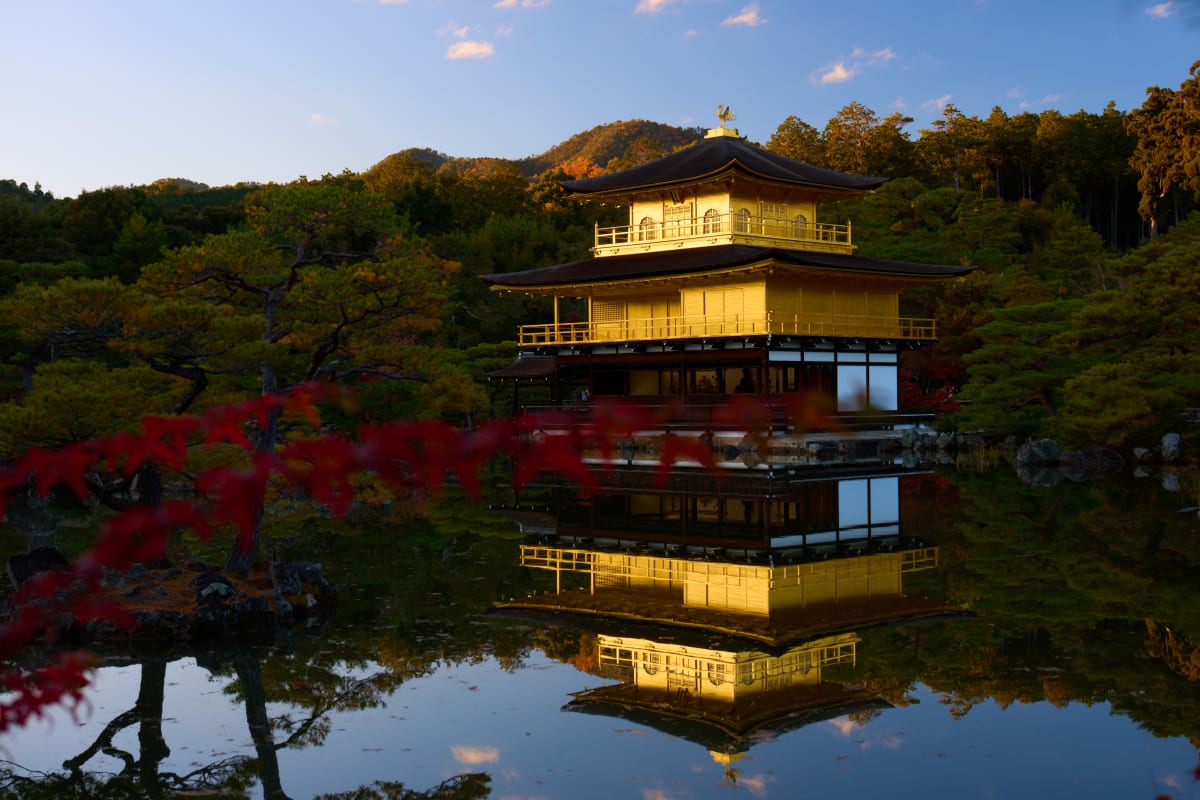
Kinkaku-ji (formally Rokuon-ji) is a Rinzai Zen temple of the Shokoku-ji branch, founded on the site of the Kitayama Villa established in 1397 by Ashikaga Yoshimitsu, third shogun of the Muromachi shogunate, and a constituent property of UNESCO's «Historic Monuments of Ancient Kyoto.» Its three-tier reliquary hall, completely covered in gold leaf, is known as the «Golden Pavilion» (Kinkaku) and gives the entire temple its popular name. The inverted reflection in Kyoko-chi pond is one of the world's most famous frames of Japanese architecture; the original burned in a 1950 arson and was rebuilt in 1955, with the gold leaf renewed in 1987 and 2003.
Highlights
- Kinkaku (Reliquary Hall) — three tiers, with about 20 kg of gold leaf on the upper two; topped by a phoenix in the Zen Buddhist style. The reflection in Kyoko-chi pond is the classic frame
- Kyoko-chi Pond — punctuated by nine borrowed islands and stones; on a windless day, a perfect mirror, especially after rain
- Rikushu Pine — said to have been planted by Yoshimitsu, this ~600-year-old pine is pruned to resemble a boat
- Sekkatei Tearoom — an Edo-period tea pavilion visited by Emperor Gomizunoo; its name evokes «watching the Golden Pavilion glow at sunset»
- Snow-capped Kinkaku — central Kyoto sees snow only a handful of times a year, making the snow-and-gold contrast a once-in-a-lifetime subject
Quick Answers
What is Kinkaku-ji?
A Rinzai Zen temple — formally Rokuon-ji — founded on the site of the Kitayama Villa built in 1397 by shogun Ashikaga Yoshimitsu. Its three-tier reliquary hall covered entirely in gold leaf is called «Kinkaku» (Golden Pavilion) and the temple is a constituent property of UNESCO's «Historic Monuments of Ancient Kyoto.»
Tips for photographing Kinkaku?
Right at 9 AM opening in forward light (facing south) is best. A polarizing filter helps tune the water reflection for a vivid mirror image. After rain also yields beautiful mirror shots. Tripod use is restricted in some zones — confirm in advance.
When is the best season to visit?
Beautiful year-round, but cherry blossoms in late March, fresh green in May, and autumn colors mid-to-late November all add color. Snow-capped Kinkaku is rare — only a few days from late December to February. Winter mornings below 0 °C produce the clearest pond mirror.
Hours and admission?
9:00–17:00 daily, year-round. Adults ¥500, elementary/middle school ¥300. Goshuin (shrine seal) ¥300 extra. To avoid crowds, visit 9:00–10:00 right at opening or 16:00–17:00 before closing. Spring and autumn (school trip seasons) are crowded even on weekdays after 10 AM.
How do I get there?
From Kyoto Station, City Bus 101 or 205 to «Kinkakuji-michi» stop, then 3-min walk — 40 min total, ¥230. From Karasuma Subway Line «Kitaoji» Station, 12-min bus. Taxi from Kyoto Station ~20 min, ¥1,800. After visiting, the 10-min walk to Ryoan-ji (famous rock garden) is a classic pairing.
What about the 1950 fire and the current building?
On July 2, 1950, a novice monk set the original (Kamakura-era) Kinkaku ablaze, destroying it. The current building was reconstructed in 1955, with gold leaf renewed in 1987 and 2003. Yukio Mishima's 1956 novel «Kinkaku-ji» fictionalized the event and remains a touchstone of modern Japanese literature.

Practical Information
- Access
- 3-min walk from «Kinkakuji-michi» bus stop.
- Parking
- Paid parking (¥300/40 min).
- Admission
- Admission ¥500 (adult).
- Duration
- 30-45 min.
- Best Time
- Right at 9 a.m. opening. Winter snow scenes are unrivaled.
More in Kyoto
Related Content
Photography Techniques
Collections & Tags