कानाज़ावा
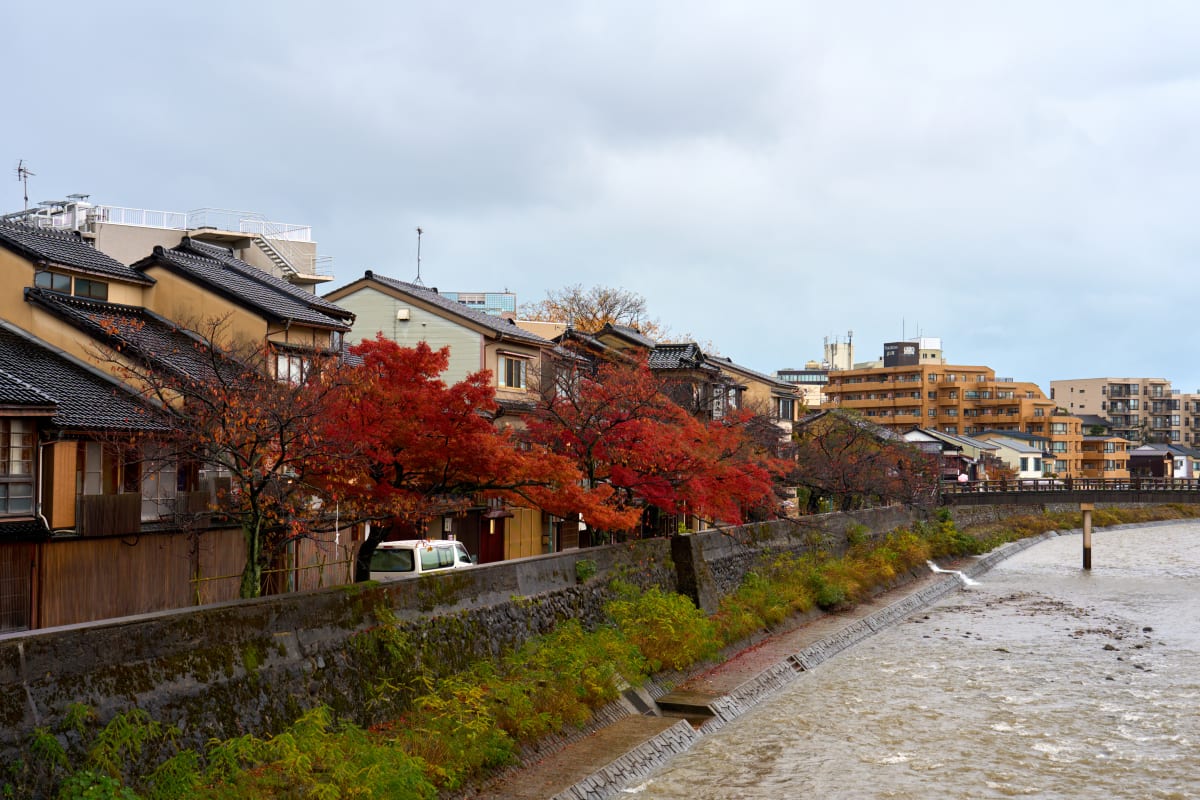
Kanazawa, the capital of Ishikawa Prefecture and the largest city in the Hokuriku region with about 460,000 residents, became a Maeda-clan castle town in 1583 when Maeda Toshiie took residence. For about 290 years until the Meiji Restoration, it flourished as the seat of the Kaga domain's «one-million-koku» wealth, blooming into «Kaga Hyakumangoku» culture. With Kenrokuen (landscaped from 1676, one of Japan's Three Great Gardens and a Special Place of Scenic Beauty), Kanazawa Castle (1583), three preserved tea-house districts (Higashi Chaya, Kazuemachi, Nishi Chaya), the Nagamachi samurai houses, the Omicho Market (one of Japan's three great markets), and the 21st Century Museum, it remains a rare castle town where Edo-period streetscapes, contemporary art, and traditional crafts (gold leaf, Kutani pottery, Kaga Yuzen dyeing) coexist.
Highlights
- Kenrokuen — landscaped from 1676, one of Japan's Three Great Gardens and a Special Place of Scenic Beauty; the winter rope-suspended pines (yukitsuri) and the Kotoji Lantern at Kasumigaike Pond are emblematic
- Kanazawa Castle Park — the seat of the Kaga domain's Maeda clan, with white-stucco namako-kabe walls and dramatic evening illumination
- Higashi Chaya District — established in 1820 as a major tea-house district, a Designated Important Preservation District, with red-lattice machiya and lanterns at dusk
- Kanazawa Station Tsuzumi Gate — opened 2005, fusing a 13.7 m traditional drum-shaped gate with a modern glass dome, beautifully lit at night
- 21st Century Museum of Contemporary Art — opened 2004, designed by SANAA as a circular glass building, including Leandro Erlich's «Swimming Pool»